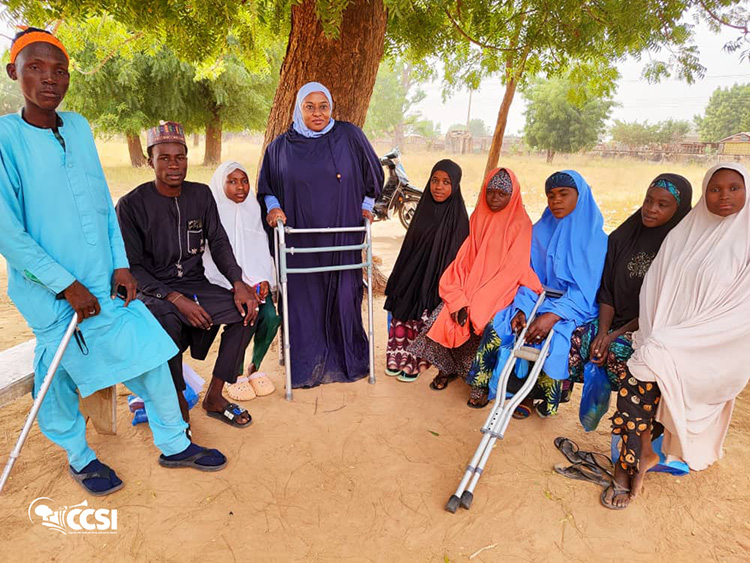
“We are people like everyone else. Our disability should not be a barrier to accessing health services.”
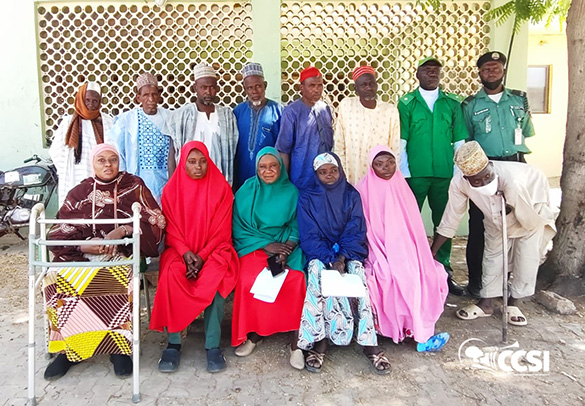
For Bilkisu Ado Zango, these words are not a slogan. They are a life’s argument—shaped by lived experience, sharpened by struggle, and sustained by an unyielding belief in dignity and inclusion.
An advocate for the rights of Persons with Disabilities (PWDs), Bilkisu is one of the Implementing Faith and Cultural Champions (IFCCs) of the Faith and Cultural Champions (FCC) project implemented by the Centre for Communication and Social Impact (CCSI). Her story is one of quiet courage, relentless determination and purposeful impact.
Bilkisu’s advocacy began early. While still a secondary school student in Kano State, she served as secretary of an association for PWDs, learning firsthand the power of organisation, voice and solidarity. Even then, she understood that change rarely begins in grand halls; it starts where exclusion is felt most keenly.
At Bayero University Kano (BUK), where she studied English, the realities of living with a disability became even more pronounced. “Although I faced difficulties from childhood, the real challenge came at BUK,” she recalls. “The library was several floors up, and as a person with disability, I could not access it.”
Everyday routines—moving between lecture halls, going to the mosque, getting meals from the cafeteria—became daily tests of endurance. Yet Bilkisu refused to be defined by barriers designed without her in mind. She pressed on, navigating a system that did not anticipate her presence, let alone accommodate it.
She graduated with a bachelor’s degree in English and went on to join Radio Kano as a casual staff member. Through commitment and competence, she rose through the ranks to become an Editor. The newsroom became her platform—not just for broadcasting news, but for amplifying the voices of those often unheard, particularly people living with disabilities.
Over the years, Bilkisu has worked with organisations advancing the health and wellbeing of women and children, contributing her expertise to disability-inclusive programme design and implementation. She has also mentored girls with disabilities across Nigeria, creating safe spaces for dialogue, encouragement and self-expression.
“I bring these girls together and we talk about life,” she says. “Sometimes we even go on radio programmes together. I teach them to speak up about issues that concern them.”
Today, as one of 23 IFCCs selected through a rigorous process under the FCC project, Bilkisu is poised to deepen her impact. Her mission is clear: to advocate for disability-inclusive healthcare and improve access to maternal, newborn and child health, as well as child spacing services for PWDs in Kano State.
“The disability community trusts me,” she explains. “As a journalist, a person with disability, and an advocate, I have built credibility over the years. That trust is a responsibility.”
Her concerns are grounded. Many primary healthcare centres, she notes, lack basic infrastructure such as ramps, accessible beds and walkways. Even more troubling is the absence of data on PWDs accessing health services—an invisibility that perpetuates neglect.
“Many of our members avoid hospitals because they are embarrassed,” she says. “Some are carried onto delivery beds. Others avoid child spacing services because of the looks they get. We are judged for everything.”
This is what Bilkisu wants to change.
“Being disabled does not mean we should not receive support to have children and space them safely,” she insists. Her approach includes sensitisation campaigns for PWDs, their families—husbands, mothers-in-law—and health workers, challenging prejudice while building empathy and understanding.
Following her engagement as an IFCC in August 2021, Bilkisu joined other champions in Kano to co-create strategies and activities tailored to their communities. Her plan includes training 20 champions in each of her six implementing local government areas to promote antenatal care, immunisation and health facility delivery among PWDs.
Through radio programmes, social media campaigns and community engagements, she will raise awareness, encourage PWDs to speak out, and work with health workers, religious leaders and community stakeholders to identify barriers and co-create practical solutions for accessible healthcare.
For Bilkisu, becoming an IFCC is not a departure—it is a continuation. This time, however, she is equipped with structured support: targeted training, guiding materials, and the mentorship of Advisory Faith and Cultural Champions (AFCCs)—respected faith and cultural leaders who provide direction to the FCC project.
With these tools, she is committed to advancing dignified, non-judgemental maternal and child health services for PWDs across Kano State.
As Bilkisu steps into this new phase of her journey, her resolve remains steady. Barriers may still exist, but so does her determination to dismantle them—one conversation, one community, one health facility at a time.
And as she does, there is little doubt that mountains will move.
We are excited to follow Bilkisu’s journey, and we will be supporting and cheering her on as she implements her exciting activities.
We can’t wait to see the mountains she will move.