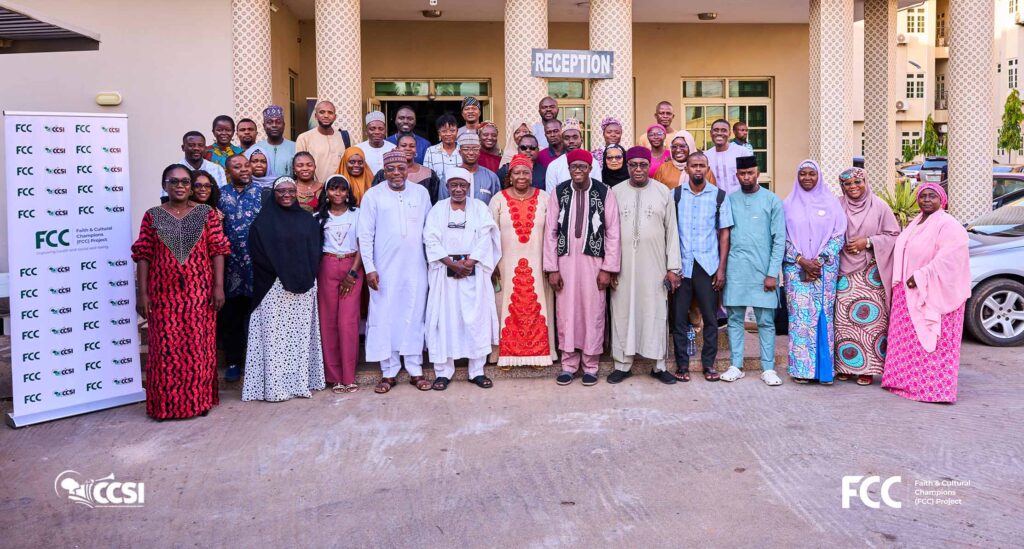
As the morning sun spreads across Kaduna, traditional and religious leaders from different faiths and cultural backgrounds gather with a shared purpose: to validate materials that could help shift norms and behaviours detrimental to the health and well-being of adolescent girls and young women in Kano and Kaduna States.
This was more than a routine meeting. It was a working session grounded in dialogue, collaboration, and shared responsibility. The participants included influential traditional and religious leaders serving as Advisory Faith and Cultural Champions (AFCCs), who provide strategic guidance to the Faith and Cultural Champions (FCC) Project. Also present were the Implementing Faith and Cultural Champions (IFCCs)—leaders and organisations tasked with rolling out activities aimed at improving maternal, newborn and child health (MNCH), as well as child spacing services for adolescent girls and young women in the two states.
The FCC Project is a three-year learning agenda implemented by the Centre for Communication and Social Impact (CCSI) with support from the Gates Foundation. Earlier in August, a co-creation workshop was held with the IFCCs, selected through a rigorous process, to jointly develop workplans and implementation strategies. From these workplans, social and behaviour change (SBC) materials were produced. The Kaduna convening brought together the IFCCs, AFCCs, and the FCC project team to adapt and validate these materials—ensuring cultural sensitivity, religious accuracy, and contextual relevance.
Taking the Message to the People
The FCC Project employs a range of carefully selected communication channels to reach communities. Guided by faith and cultural leaders, these channels are designed to deliver messages that are both culturally appropriate and religiously grounded, with the goal of improving the health and well-being of adolescent girls and young women.
Key platforms include Friday Juma’at sermons in mosques and Sunday services in churches, using sermon guides developed and validated with input from religious scholars in both states. Beyond places of worship, the project also engages communities through meetings with husbands of adolescent girls and young women, community leaders, and mother-in-laws, as well as compound meetings with adolescent girls themselves. Statewide radio programmes further extend the project’s reach.
Each engagement is guided by carefully developed messages, validated by both AFCCs and IFCCs, ensuring consistency, credibility, and impact across all platforms.
Co-Creating Systems That Last
Since its launch in November 2024, the FCC Project has followed a deliberate, step-by-step process that has strengthened its foundation across Kano and Kaduna States. Recognising the deep influence of faith and cultural leaders, the project began by establishing the AFCCs—a body of highly respected leaders drawn from Islamic and Christian institutions, as well as senior members of the Kano and Zaria Emirate Councils.
These leaders serve as the project’s moral and strategic compass, opening doors, offering guidance, and facilitating access to communities. In April 2025, a co-creation workshop was held in Kano State with the AFCCs to identify priority harmful norms and practices, develop communication strategies, and establish criteria for selecting the IFCCs. Over three intensive days, the leaders demonstrated remarkable commitment, guiding the project’s focus areas and shaping its implementation framework.
Following the selection of the IFCCs in both states, a second co-creation workshop was organised to refine their workplans and deepen their understanding of the project’s objectives, scope, and guiding principles. The IFCCs—comprising individuals and organisations with strong community presence and proven experience—also included persons with disabilities, ensuring inclusivity in both messaging and implementation. During the workshop, each IFCC presented their plans, received feedback, and refined their strategies collaboratively.
With their messages now validated and adapted into comprehensive sermon guides on MNCH and child spacing—woven with parables, cultural proverbs, and references from both the Bible and the Qur’an—the IFCCs are well positioned to use their influence to challenge harmful norms and promote healthier practices.
Faith and Culture as Drivers of Change
Faith and cultural leaders have long played a central role in addressing social issues in Nigeria. Often described as community gatekeepers, their influence extends beyond mosques, churches, and palaces into the everyday lives of the people they serve. In northern Nigeria especially, they are widely regarded as the moral conscience of their communities.
At the same time, deeply rooted harmful practices have continued to undermine the health and well-being of women and girls in the region. As custodians of faith and culture, no group is better positioned to confront and reshape these norms than the leaders themselves.
By placing faith and cultural leaders at the centre of change, the FCC Project offers a powerful pathway for breaking harmful practices and improving the health and well-being of adolescent girls and young women in Kano, Kaduna, and beyond.